
If you work with software development in Brazil, the number 14 is etched into your DNA. The CNPJ (our Company Registration Number), in the format we know, is the foundation of practically any national system. But that foundation is about to change, and the burning question is: are we prepared for the impact, or are we going to see systems collapsing as if it were the Millennium Bug (Carnival Land Version)?
The big bottleneck is that Brazil opens and closes companies at a frenetic, almost industrial pace. In 2023, we had 3.8 million new companies versus 2.1 million closures. In 2024, the bar was raised: 4.2 million openings and 2.4 million closures. And if you thought about recycling these numbers, forget it. Reusing the CNPJ of a closed company is unfeasible, as it would destroy the traceability and legal history of the business, creating a data integrity nightmare.
The Classic: How does the CNPJ work today?
Since it replaced the old CGC back in 1998, the CNPJ has followed a well-defined recipe: 14 purely numeric digits.
- Structure: 8 digits for the base, 4 for the branch prefix (the famous 0001), and 2 check digits (DV).
- Validation: The calculation of the DVs uses the Modulo 11 Algorithm. It’s simple, performant, and any intern can implement it in 10 minutes.
The problem? Success killed the system. The stock of numeric combinations for the 8-digit base is running out. The Federal Revenue (once again, our IRS) had to act.
A side note here… does anyone still remember the CGC?
Google it and it will appear.
Or am I the only one who has had a PIC 9(14) CGC running in prod?
Getting old in technology is like that.
The Change: The “Alphanumeric” comes into play
Instead of simply increasing the field size to 15 or 16 digits, which would break the layout of all remittance files and invoices in the country… the solution was to keep the 14 characters, but allow letters.
In the new format, the positions of the base and the branch can contain letters and numbers. The validation algorithm is still Modulo 11, but with a twist: there is now a conversion table where each letter corresponds to a decimal value (the ASCII value minus 48), in the style of the new vehicle license plate – which also changed to a MERCOSUR standard in Brazil, roughly in 2019.
Why not just add more digits? Pure war economy. If you add a digit, you break EDI layouts, physical form fields, fixed-width text files (COBOL sends its regards), and user interfaces across the entire country. Keeping 14 characters is an attempt to mitigate the damage, although the type change (from number to string) is already a bomb in itself.
But, the truth is: every time something “immutable” changes, the market panics.
It was like that with the millennium bug. It was like that with IPv4 → IPv6. And now… it’s the CGC’s… oops, CNPJ’s turn.
The Technical Nightmare: Typing and Legacy Systems
This is where the rubber meets the road. For modern applications (Go, Rust, Swift, Java, Python, Node), changing from a long or BigInt to a String is at most annoying, but manageable. The real problem is the Legacy Systems.
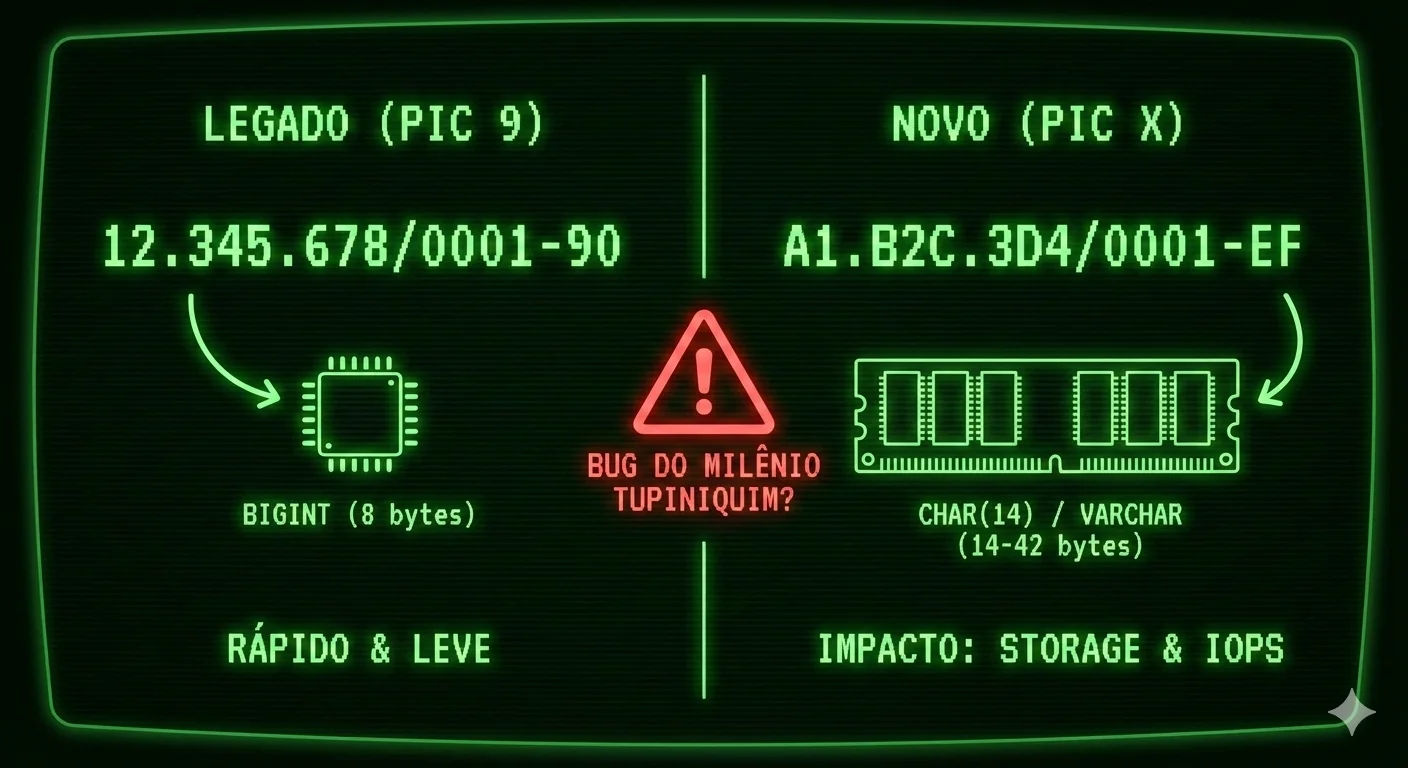
- COBOL and Lowly-Typed Languages: Many old systems treat the CNPJ as a strictly numeric field to perform validation calculations or automatic masks. Changing the PIC 9(14) to PIC X(14) may require a mass recompilation and exhaustive regression testing.
- Discontinued Systems: You know that 2005 ERP that the company still uses but the vendor went bankrupt? It will stop validating new customers. Simple as that. The cost of “hacking” the binary or creating a validation wrapper can be prohibitive.
The Impact on the Database: Performance and Cost
Let’s talk about “bit twiddling.” In the old format, many DBAs optimized the storage. The current CNPJ requires a BIGINT (8 bytes) or a decimal. Now, with the alphanumeric format, we are forced to use CHAR(14) or VARCHAR(14).
| Attribute | Old Format (BIGINT) | New Format (CHAR/UTF8) |
| Storage | 8 Bytes | 14 to 42 Bytes (depending on the charset) |
| Comparison | Fast (CPU Level) | Slow (Byte-by-byte String Comparison) |
| RAM Consumption | Low | Significantly higher in large buffers |
Indexes and Searches:
If your system uses the CNPJ as a Primary Key (PK) or has a heavy index on it, get ready. Indexes on text columns are naturally slower and more voluminous than numeric indexes.
But let’s be realistic: in well-designed applications, the CNPJ is rarely the PK (we usually use a UUID or an auto-incrementing ID). If it is just a search column (Unique Key), the real impact on the user experience will be minimal, but the storage cost and IOPS of your database will go up.
Houston, do we have a problem?
It’s not the end of the world, but it is a necessary and almost invisible maintenance. The biggest risk is not in the modern database, but in the integration. The Brazilian ecosystem is a web of systems exchanging text files. If a validator in the middle of the road blocks a letter, the entire chain stops.
The “New CNPJ” will not bring down airplanes, but it will make many developers work nights in 2025/2026 cleaning up code that assumed “CNPJ is just numbers.”
Therefore, dear padawan, if you have to Venmo Uncle through my CNPJ, do it before June. If you can before 12/31/2025, Uncle will be grateful.
Happy Holidays and a Happy 2026.
Visit our Blog
Learn more about databases
Learn about monitoring with advanced tools
Have questions about our services? Visit our FAQ
Want to see how we’ve helped other companies? Check out what our clients say in these testimonials!
Discover the History of HTI Tecnologia